
Next-Generation District Heating: Why Urban Heat Networks Matter Again for Europe
Europe’s energy transition is often discussed through electricity. Solar panels, wind farms, electric vehicles, smart grids, and batteries receive most of the public attention. Yet one of the most important parts of the energy system is not always visible in these conversations: heat. Homes, offices, hospitals, schools, factories, and public buildings all need heating, and in many European countries this demand remains one of the hardest areas to decarbonize. This is why district heating, or centralized urban heat networks, is returning as a strategic topic.
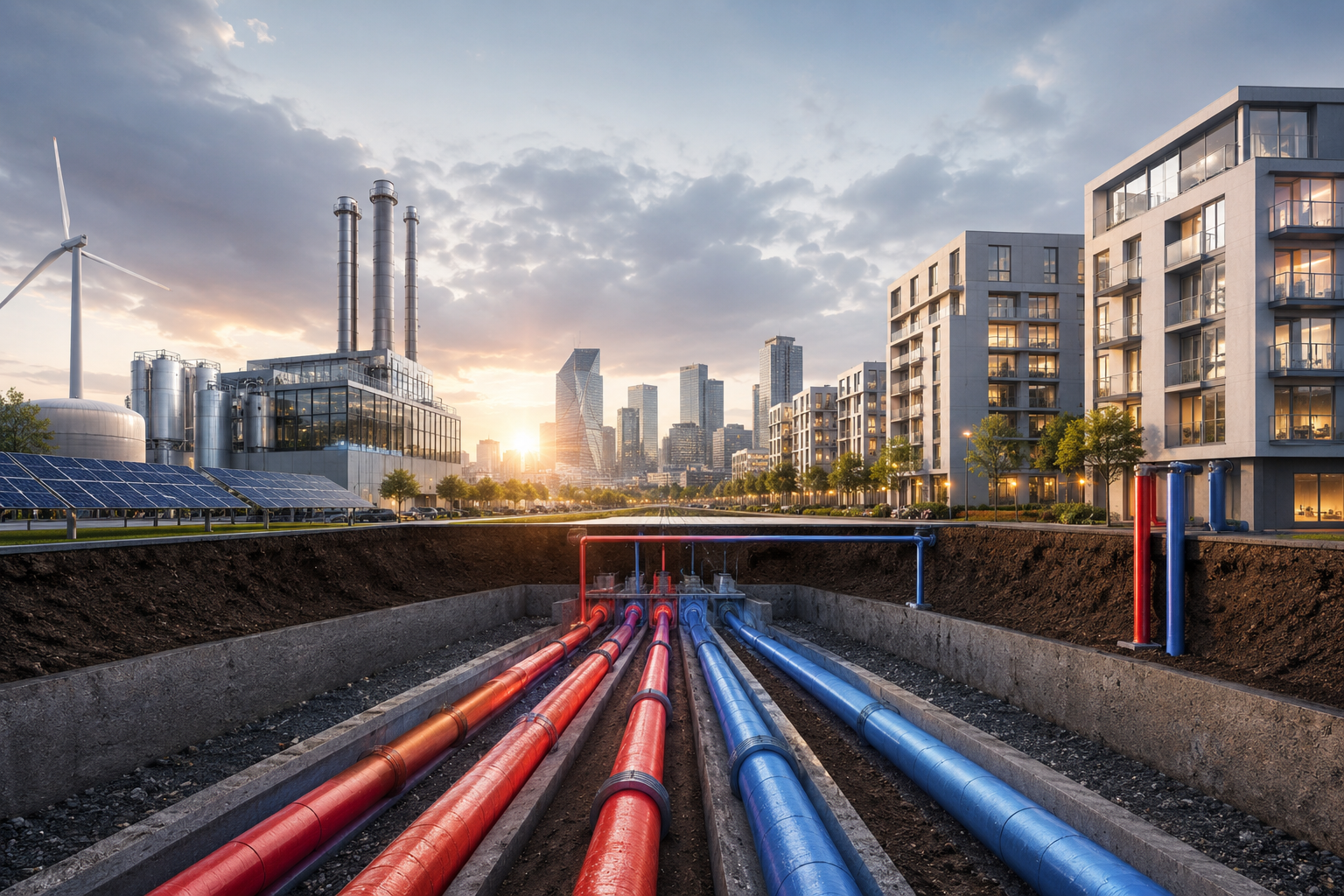
District heating is not a new idea. Many cities have used centralized heat networks for decades. Heat is produced in one or several locations and distributed to buildings through insulated pipes, usually in the form of hot water. The concept is simple: instead of every building relying on its own boiler, a shared network supplies heat more efficiently. What is changing today is the purpose and potential of these systems. District heating is no longer just an old municipal service. It can become a platform for renewable heat, waste heat recovery, thermal storage, and more resilient urban energy planning.
Heat as the Forgotten Side of the Energy Transition
The energy transition cannot succeed through clean electricity alone. Heating and cooling represent a large share of energy demand in buildings and cities. If Europe electrifies transport and expands renewable power but leaves heating dependent on fossil fuels, the transition remains incomplete.
This is especially important in dense urban areas. Many apartment buildings cannot easily install individual heat pumps. Historic buildings may have technical limits. Low-income households may not afford major renovation. In these situations, district heating can offer a shared solution. Instead of asking every building owner to solve the heat problem alone, the city can modernize heat supply at network level.
This does not make district heating automatically green. Older systems may still depend on coal, gas, or inefficient infrastructure. But the network itself creates an opportunity. Once buildings are connected, the heat source can change over time. A fossil-based system can gradually incorporate geothermal heat, industrial waste heat, large-scale heat pumps, biomass where appropriate, solar thermal systems, or recovered heat from data centers and wastewater.
From Old Pipes to Smart Networks
Traditional district heating systems were often designed around large centralized plants and high-temperature water. They worked, but they were not always flexible. Next-generation heat networks are different. They aim to operate at lower temperatures, reduce heat losses, integrate multiple sources, and use digital control to match supply and demand more precisely.
Lower-temperature networks are important because they can use a wider range of renewable and recovered heat sources. Industrial waste heat, for example, may not always be hot enough for older systems without additional processing. Modern networks can be designed to capture and distribute such heat more efficiently. Large heat pumps can also raise low-temperature heat to useful levels.
Digitalization adds another layer. Sensors, smart meters, predictive control, and digital twins can help operators understand how heat moves through the system. They can detect losses, adjust temperatures, forecast demand, and optimize storage. In the past, a heat network was mostly a physical infrastructure. In the future, it will also be an information system.
Waste Heat as a Local Resource
One of the strongest arguments for district heating is the ability to use heat that would otherwise be wasted. Cities generate enormous amounts of unused heat. Factories release it. Supermarkets and cold storage facilities reject it. Data centers produce it constantly. Metro systems, wastewater treatment plants, and industrial sites all contain potential heat resources.
Without a network, this heat often disappears into the air or water. With district heating, it can be captured and reused. This changes how a city thinks about energy. Heat is no longer only imported as fuel. It becomes something already present in the urban environment.
This is especially relevant for Europe, where energy security has become a central concern. A city that can reuse local heat is less exposed to imported fossil fuels and volatile prices. It also turns local infrastructure into part of the climate solution.
Thermal Storage and Flexibility
Electricity systems need flexibility because renewable power is variable. Heat systems need flexibility too. Demand rises during cold mornings, changes across seasons, and depends on building behavior. District heating can use thermal storage to manage these patterns.
Thermal storage can be short-term or seasonal. A hot water tank can store heat for hours or days. Larger underground systems can store heat for longer periods. This allows cities to capture heat when it is available and use it when it is needed. For example, surplus renewable electricity can power large heat pumps when electricity is cheap or abundant. The heat can then be stored and distributed later.
This connection between electricity and heat is one reason district heating is becoming more strategic. It can help balance the broader energy system. Instead of treating heating as a separate problem, cities can use heat networks to link renewable power, storage, and building demand.
The Challenge of Modernization
The return of district heating does not mean that every existing system is ready for the future. Many networks require major investment. Pipes may be old. Heat losses may be high. Temperatures may be inefficient. Customers may distrust centralized systems if prices are unclear or service quality is poor.
Modernization must therefore be both technical and social. Cities need transparent pricing, reliable service, strong regulation, and clear communication. People must understand why connection to a heat network benefits them. If district heating is presented only as an infrastructure project, public support may remain weak. If it is presented as a tool for stable heating costs, cleaner air, local resilience, and lower emissions, the argument becomes stronger.
The success of district heating also depends on urban planning. Networks work best where heat demand is dense enough to justify investment. This makes them especially suitable for apartment blocks, campuses, public buildings, hospitals, and mixed-use districts. In scattered rural areas, other technologies may be more practical.
A Strategic Role for European Cities
European cities are under pressure to cut emissions, reduce energy dependence, protect households from price shocks, and modernize aging buildings. District heating can support all of these goals when designed correctly. It gives municipalities a way to plan heat supply at scale rather than leaving every building to make isolated decisions.
The next generation of urban heat networks will not look the same everywhere. In one city, geothermal energy may be central. In another, industrial waste heat may dominate. A third may rely on large heat pumps, thermal storage, and renewable electricity. The strength of district heating lies in this flexibility. The network can adapt to local resources.
This is why centralized heat supply is becoming important again. It is not nostalgia for old municipal infrastructure. It is a practical response to a complex energy transition. Europe needs clean electricity, but it also needs clean heat. It needs efficient buildings, but also systems that support buildings that cannot be renovated quickly. It needs individual action, but also shared infrastructure.
District heating matters because it turns heating from a private building problem into an urban energy strategy. In a future where cities must be cleaner, more resilient, and less dependent on fossil fuels, that shift may be essential.
Leave a Reply